NDE Research – A Data-Driven Journey into the Depths of Human Boundary Experiences
Near-death experiences (NDEs) are among the most profound and at the same time most enigmatic phenomena reported by humans. They touch on themes such as light, consciousness, fear, encounters, timelessness, and transformation—and they raise a fundamental question:
Do these accounts reflect purely individual experiences, recurring patterns, or structured narrative forms?NDE Research represents one of the most extensive independent investigations in the German- and English-speaking research landscape to date.
More than 1,250 YouTube interviews have been collected, transcribed, cleaned, and analyzed using methods of descriptive statistics, semantic analysis, hypothesis testing, clustering, and ongoing factor analyses.
In parallel, a dedicated language-based model is currently under development to capture narrative patterns with even greater precision.
1. Research Objective
1. Identifying Shared Structures in Near-Death ExperiencesThe central aim of this research is to identify recurring structural patterns in near-death experiences (NDEs). Although each experience is deeply personal, people around the world report strikingly similar motifs—such as an indescribable sense of love, a feeling of complete acceptance, or the impression of “coming home.”These recurring descriptions raise a fundamental question:Are these similarities coincidental—or do they reflect systematic patterns in human boundary experiences?To address this question, more than a thousand reports are analyzed using linguistic analysis, statistical methods, contextual evaluation, and narrative modeling.
2. Scope of AnalysisThe analysis combines qualitative insights from interviews with data-driven methods. The focus lies on the following aspects:Frequencies & Linguistic Patterns
• Which terms and motifs occur with statistically significant frequency in NDE narratives?
• At which positions within the narrative do they appear - beginning, transition, or climax?Emotional Trajectories• How do typical emotional arcs unfold—for example: fear → light → peace?
• Which emotions accompany different phases of the near-death experience?Positive vs. Negative Experiences• How do linguistic patterns of “positive” experiences (love, light, safety) differ from those characterized by darkness, isolation, or fear?
3. Patterns & Emerging HypothesesThe identification of patterns enables, for the first time, deeply grounded hypotheses about the nature of NDEs.Example: Some individuals report that during their experience they were able to perceive the emotions or even the pain of other people—often those to whom they themselves had caused suffering in the past.Such descriptions suggest that near-death experiences may not be purely individual events, but rather relational experiences connected to other people.It is conceivable that a form of collective emotional or consciousness-based reference system exists—an idea described across many spiritual traditions, such as• Buddhism (interconnected consciousness),
• Hinduism (Atman–Brahman),
• Christian mystical traditions (unity consciousness), or
• shamanic worldviews (shared experiential realms).Through systematic data-driven analysis, concepts that have long been discussed philosophically or spiritually become empirically accessible for the first time.

4. Why This MattersThe combination of:• statistical pattern recognition
• qualitative content analysis
• contextual evaluation
• and narrative modelingmakes it possible to uncover structures that remain hidden when examining individual reports in isolation.This research bridges objective data analysis with human narratives, opening a new perspective on one of the most profound topics of human existence:
consciousness, identity, and potential shared dimensions of experience.
How Does This Project Differ from Classical NDE Research?Classical studies—such as those by Greyson, van Lommel, or Long - primarily examine whether specific features of near-death experiences occur at all:
light, tunnel perception, out-of-body experiences, life review, and similar elements.
These are typically assessed using questionnaires and clinical data.This project takes a different approach.Instead of focusing solely on predefined features, it analyzes hundreds of richly narrated NDE accounts from YouTube interviews, examining how people describe their experiences—the sequence in which events unfold, the language used, and the emotional turning points within their narratives.By applying modern textual and data-driven methods, this approach reveals patterns, narrative arcs, and linguistic imagery that remain invisible in traditional scales and checklists.
The intention is not to challenge existing research, but to complement it with a narrative and linguistic perspective.
2. Research Framework
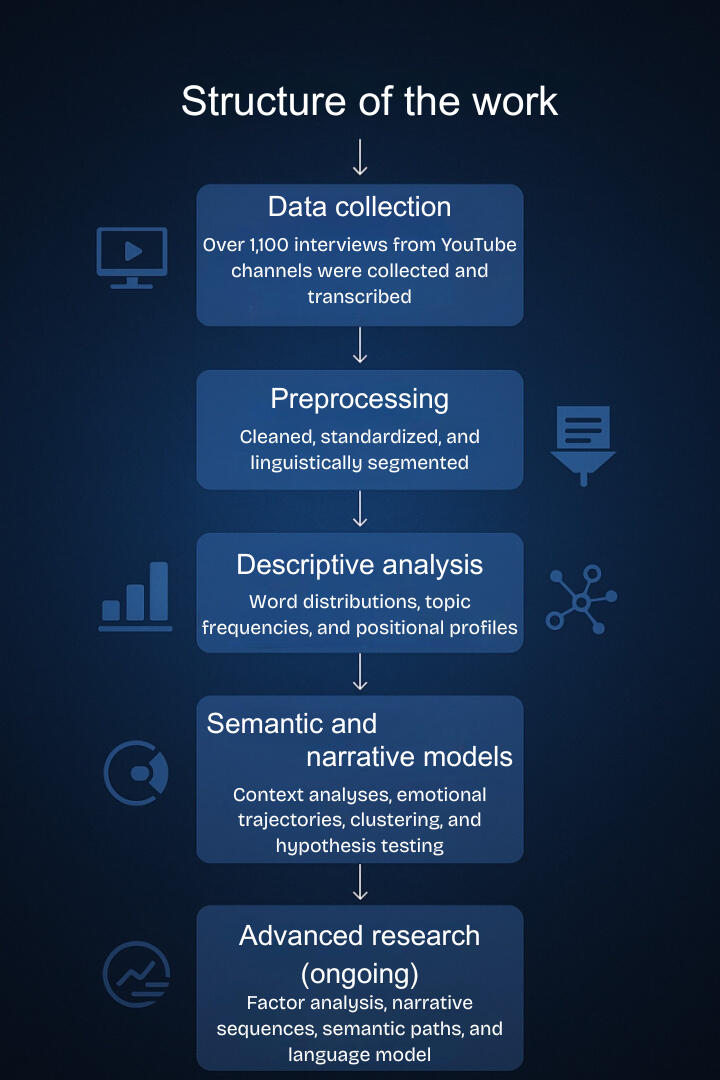
Structure of the StudyThe investigation follows a clearly structured research process—from data collection to advanced statistical and semantic analysis.1. Data Collection
More than 1,250 interviews from German- and English-speaking YouTube channels were collected and transcribed.2. Preprocessing
All texts were cleaned, standardized, and segmented according to linguistic criteria (sentences, lemmatization, positional markers).3. Descriptive Analysis
Basic patterns such as word distributions, thematic frequencies, and positional profiles were examined.4. Semantic and Narrative Models
Context analyses, emotional trajectories, clustering techniques, and hypothesis testing reveal deeper narrative structures within the reports.5. Advanced Research (ongoing)
Factor analysis, narrative sequences, semantic pathways, and a custom language model are currently under development.
3. Initial Results – Selected Highlights
1. Most Frequent Words & Thematic FieldsThe first analyses reveal clear thematic focal points.
Terms such as light, love, fear, time, tunnel, consciousness, and darkness occur with particularly high frequency and form the basis for subsequent semantic clustering.These distributions make visible:• which concepts appear across a large number of reports• how strongly certain motifs are emotionally charged• which themes recur consistently throughout the experiencesThe Top 20 words provide an initial, clear insight into the linguistic landscape of the reports.Terms such as “life,” “body,” “light,” “love,” “time,” and “God” dominate - reflecting a convergence of physical, spiritual, and emotional dimensions that frequently co-occur in near-death experiences.→ The Top 100 words are sufficient to reveal central patterns and emotional focal points.→ The most frequent terms show highly similar distributions across channels—indicating shared thematic core elements.→ The term “life” in particular occupies a central position and raises further questions regarding its narrative context (e.g., hopeful, affirmative, or contrasted with “death”).
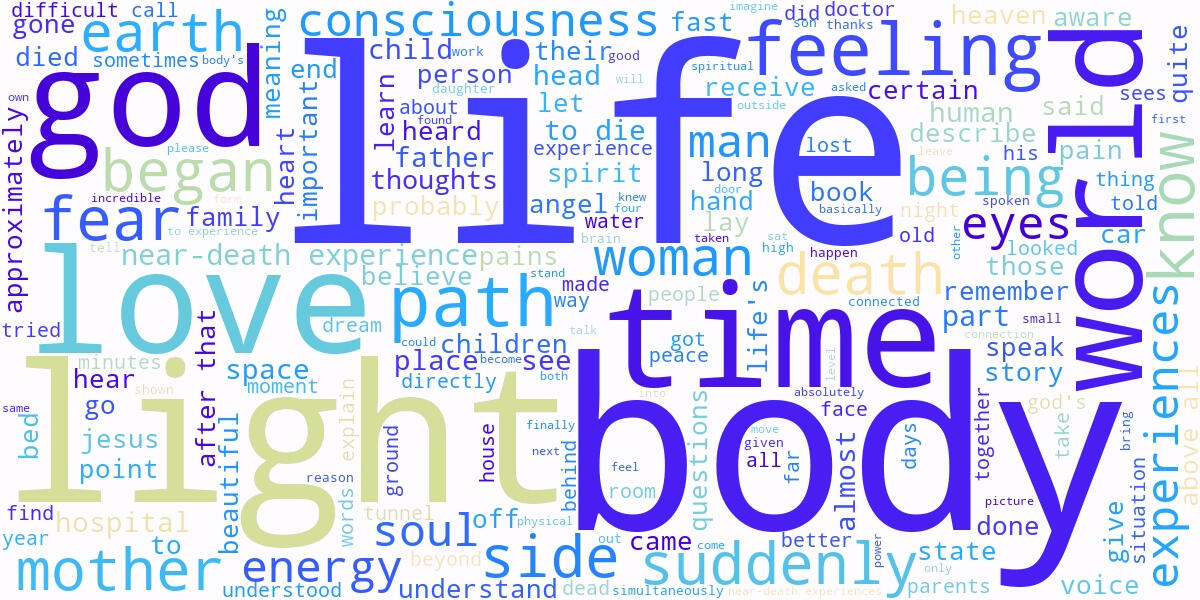
The complete dataset currently comprises more than 4 million words.
The ten most frequent terms alone — “life,” “body,” “human,” “experience,” “good,” “time,” “feeling,” “light,” “love,” and “God” — account for 75,008 occurrences.This concentration already highlights a strong thematic core shared across a wide range of individual near-death experience (NDE) reports.
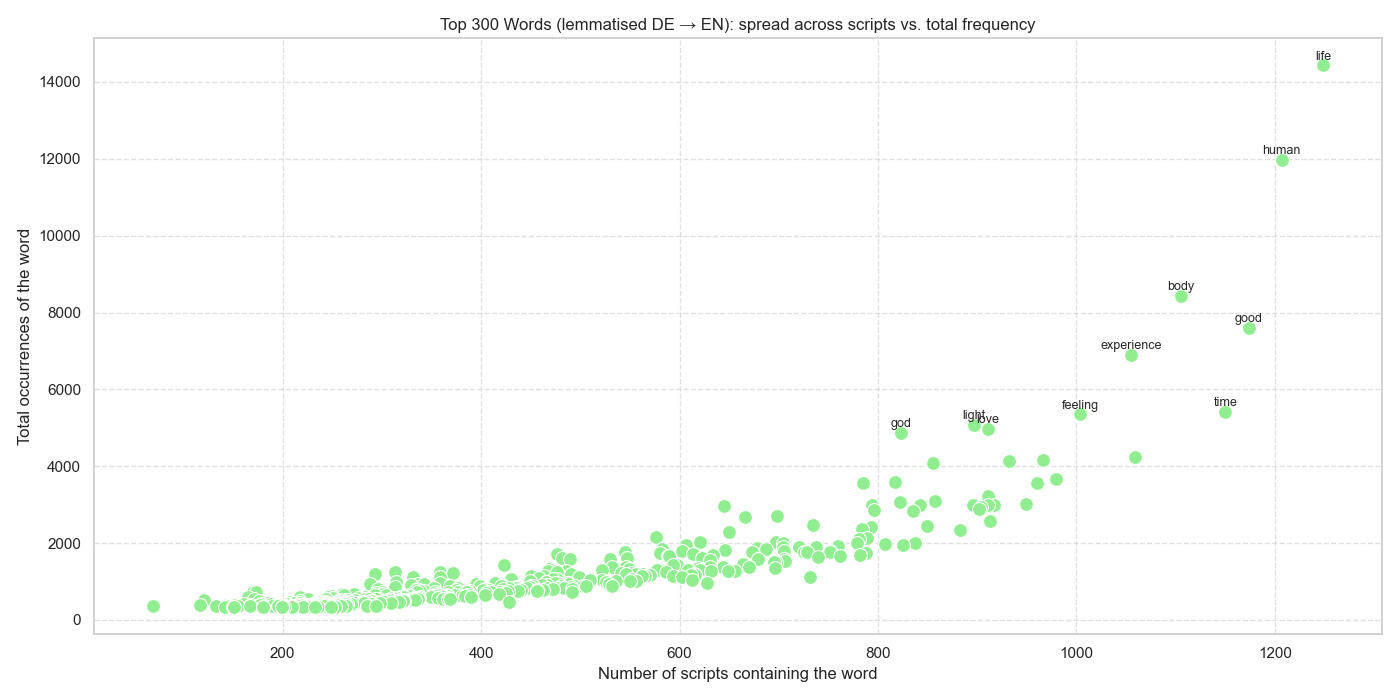
2. Correlations Between Word Frequency and DistributionA central question of the foundational analysis is:How are the overall frequency of a word and the number of transcripts in which it appears related?The correlation plots reveal:• words that occur extremely frequently across many transcripts• words that appear less often overall but are concentrated in a limited number of experiences• early indications of semantic hubs—themes shared by many individualsThe Pearson correlation between the number of transcripts and total word frequency is r = 0.81, indicating a strong positive relationship.
Words that appear in many reports also tend to occur significantly more often overall.→ Core terms such as “life,” “body,” “love,” and “light” form a stable semantic nucleus of near-death experiences.→ No outliers distort the overall distribution.→ The distribution is uniform and robust, pointing to fundamental commonalities in the central motifs.
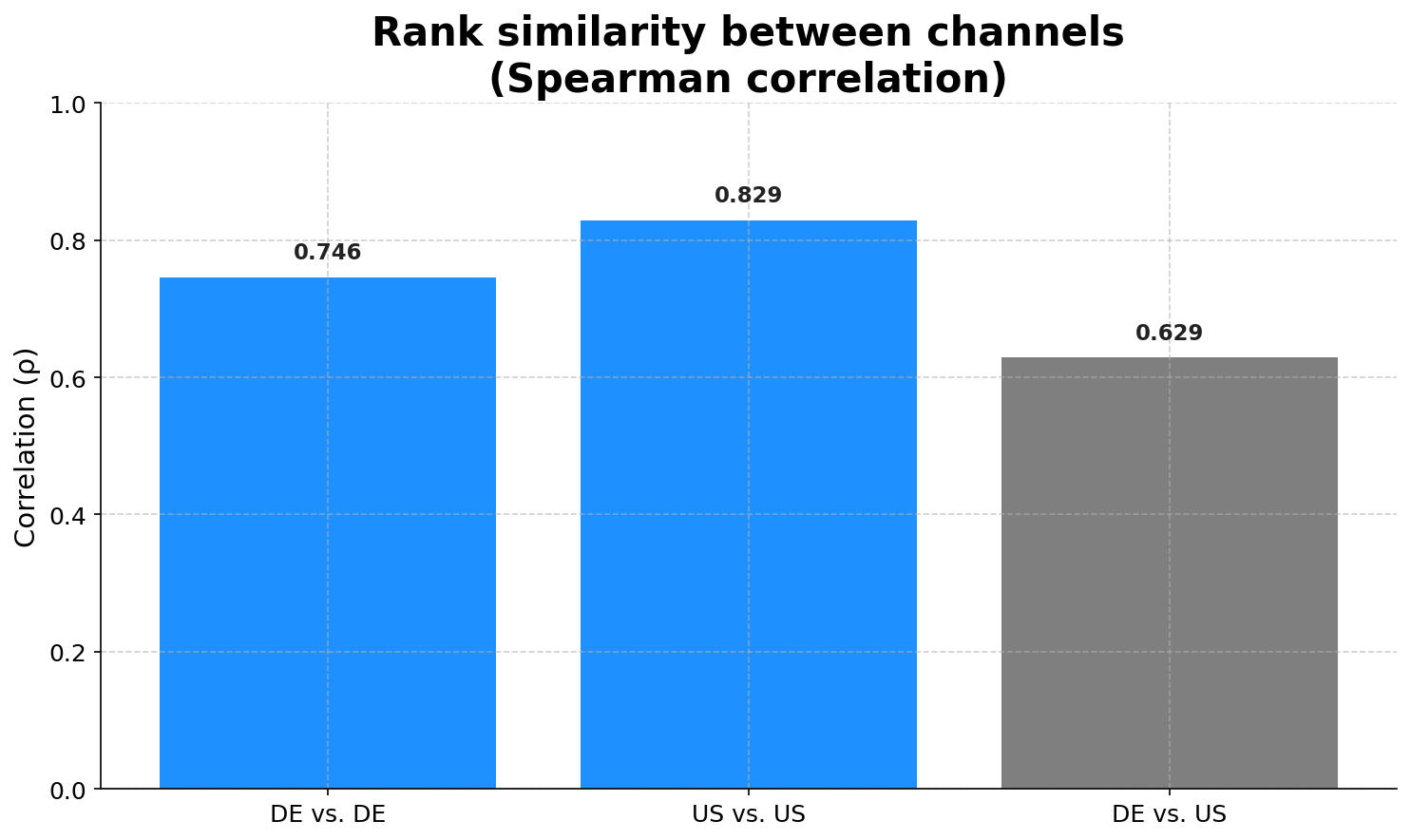
3. Spearman Rank Correlations: Germany vs. United StatesInitial comparisons reveal notable differences in linguistic structure between German and U.S.-based reports:• certain themes occur significantly more frequently in specific regions• word lengths, sentence positions, and emotional evaluations vary• culturally shaped modes of expression can be statistically identifiedChannels within the same language group show strong internal similarity,
yet German and U.S. reports still share a substantial number of common terms.→ A universal language of near-death experience becomes apparent.→ At the same time, cultural differences are clearly reflected in word choice and emphasis.
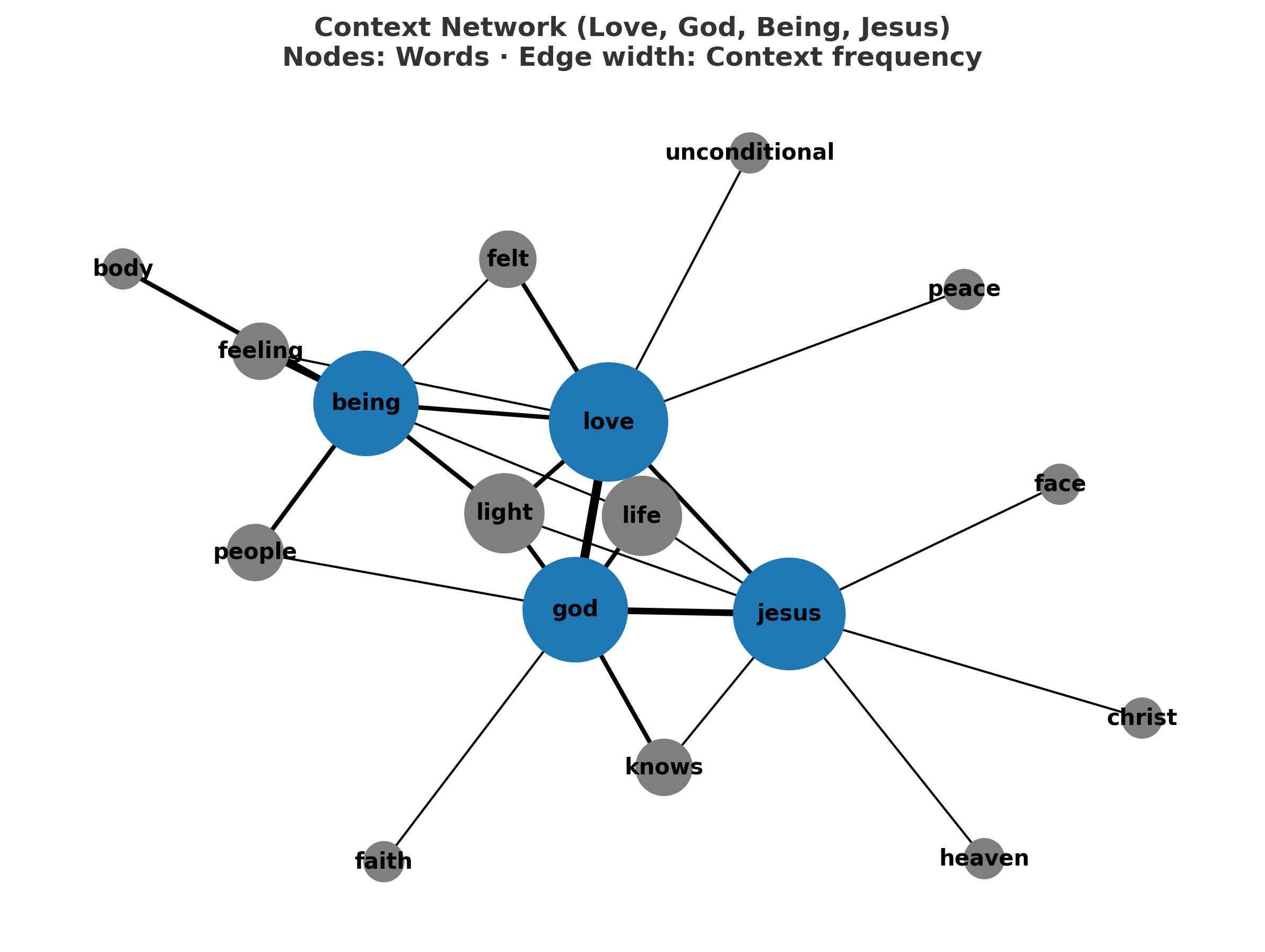
4. Context Analysis – What Is ExaminedContext analysis examines which words typically occur before or after a key term.
This allows for the precise identification of:• recurring linguistic patterns• emotional structures• spiritual and bodily motifs• cultural interpretations• narrative transitionsIn contrast to POS analysis, context analysis does not focus on grammatical categories, but on semantic surroundings:What tends to precede a word like “light” or “love”?
What follows it?
Which patterns recur across many narratives?
Completed Analytical ModulesIn addition to context analysis, several foundational analytical modules have already been fully completed:• Descriptive statistics
Analysis of frequencies, distributions, and initial structural patterns within the corpus.• POS analysis (Part-of-Speech)
Identification of dominant word classes and their functional roles within NDE narratives.• Positional analysis
Examination of where key terms appear within a narrative (e.g., beginning, transition phase, climax).• Top-word analysis (frequency & TF-IDF)
Identification of central themes, emotional hubs, and semantically relevant core terms.• Development of a structured research question framework
A systematic catalog for identifying typical NDE features, aligned with established instruments — in particular the Greyson Scale — and extended to include narrative, linguistic, and cultural dimensions.• Construction of a structured research database
A curated dataset containing over 1,250 fully transcribed interviews from German- and English-speaking sources.In addition to transcripts, the database includes metadata, language annotations, and precomputed analytical outputs, forming the technical foundation for advanced NLP, factor, and graph-based analyses.
4. Advanced Analyses
(Ongoing Work)
1. Factor Analysis (in progress)Factor analysis is used to identify latent thematic structures within the reports.
Large volumes of textual data are statistically reduced in order to reveal higher-order experience categories, emotional patterns, and recurring narrative building blocks.A central component of this process is a custom-developed research questionnaire consisting of over 40 questions.
Each question represents a typical NDE motif or narrative element, such as:• out-of-body experiences• tunnel or transition passages• encounters with light• spiritual presence• emotional transformations (e.g., fear → peace)• the moment of returnThe question framework was developed through a hybrid qualitative–quantitative approach:• Direct exchanges with cooperating YouTube channels
provided valuable insights into recurring motifs and observational patterns reported by experiencers.• Systematic qualitative content analysis
including the manual review of hundreds of interviews, enabled the identification of recurring experiential elements across narratives.• Statistical validation of qualitative findings
ensured that each motif included in the catalog is empirically anchored in the data and not based on anecdotal impressions alone.The result is a hybrid, data-driven research instrument that integrates experiential knowledge from the community with robust statistical evidence.
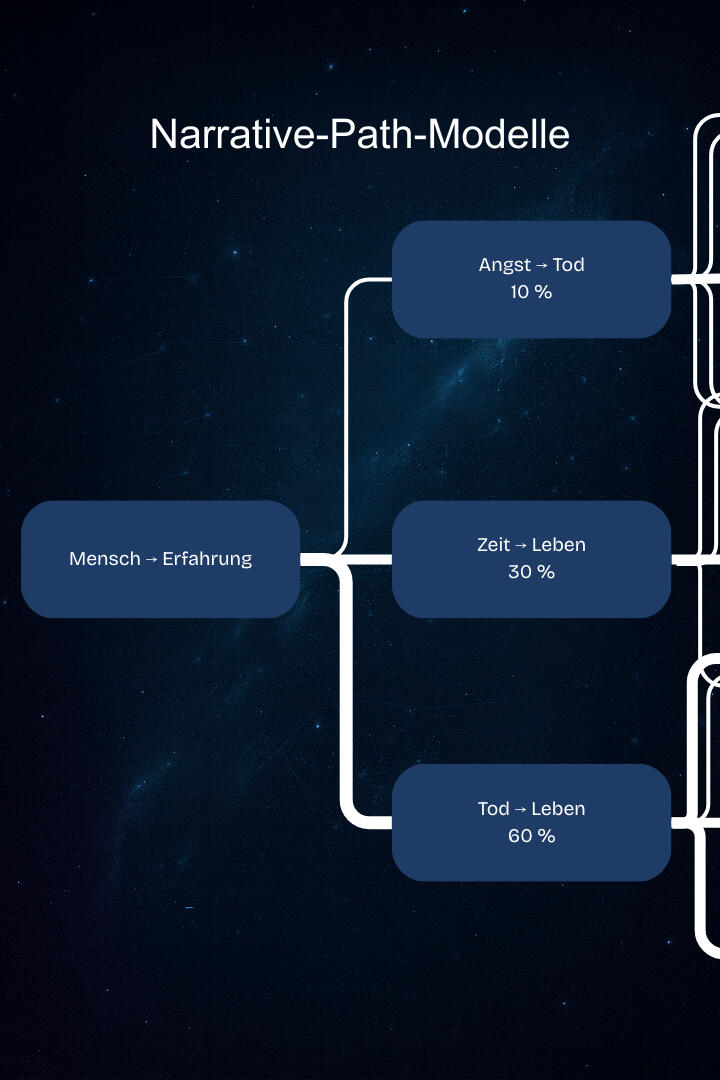
2. Narrative Path ModelsIn addition to statistical analyses, dedicated Narrative Path Models are being developed—algorithms that reconstruct typical story chains within near-death experience narratives.
These models do not focus on isolated words alone, but on the sequence in which experiences are described, revealing deeper structural patterns across reports.What the models reveal• which key terms tend to occur in succession• how emotional turning points unfold• which sequences repeatedly appear (e.g., fear → light → peace → return)• and which variants are rarer but potentially meaningfulThese models will later serve as a foundation for storyline prediction:
how narratives typically develop—and where they diverge.To illustrate the complexity of a full Narrative Path Model, here is an exemplary (complex) example showing only the initial layer Human → Experience:• Exemplary Narrative Model.pdfThe figure represents a highly simplified visual layer of the underlying model and is included solely to improve readability.
3. Custom Language Model (LLM)A custom language model is currently being developed, trained on more than 1,250 NDE transcripts.
The goal is a domain-specific LLM capable of:• detecting typical NDE motifs• understanding narrative transitions• automatically mapping semantic clusters• and later identifying patterns in new reports with minimal manual effortThis model is trained iteratively and is intended to become a core component of the project in the long term—especially as new datasets and narrative path structures are added.
4. Research Database (in development)To organize the continuously growing volume of transcripts, analyses, and statistical outputs, a central research database is currently being built.
It forms the backbone of the project and enables a systematic, reproducible, and scientifically traceable evaluation of hundreds of near-death experience reports.• The database aims to consolidate all components in one structured environment, including:• full transcripts of all NDE reports• metadata (e.g., source, year, language, interview length)• quantitative analysis outputs (POS, frequencies, n-grams, etc.)• narrative and emotional patterns• results from semantic models• context and cluster structures• path sequences derived from Narrative Path ModelsStep by step, this creates a scientific foundation that supports both internal research workflows and future collaboration with external partners.
5. Downloads
Key Results, Methods, and Analyses — Compact OverviewThe brochure summarizes all project steps completed so far:
from data collection and statistical analyses to semantic evaluations and the first identified narrative patterns.It provides a clear and accessible overview of the research design and presents key diagrams, findings, and exemplary excerpts from more than 1,250 near-death experience reports.The brochure is continuously updated as soon as new models, clusters, or hypothesis tests are completed.
Click the download button below to access the brochure.Downloads:Brochure DE: December 2025Brochure EN: December 2025

6. Cooperation / Partnerships
NDE Research is an independent project that is open to collaboration—both with individuals and institutions.Whether through scientific analysis, data exchange, interviews, media contributions, or joint research initiatives:
any form of cooperation can contribute to a deeper and more comprehensive understanding of near-death experiences.Current collaborations (selection):YouTube channels (ongoing data collection & exchange):
• Einblicke ins Jenseits• Empirische JenseitsforschungIf you are interested in joint projects or would like to contribute ideas, I would be pleased to hear from you.
7. Donations / Support

This project analyzes more than 1,250 near-death experience reports using methods from statistics, semantic analysis, and narrative research.
All results are shared openly — without paywalls or commercial intent.However, the creation of transcripts, data pipelines, diagrams, visualizations, and ongoing analyses
(such as factor models, language-based models, and semantic clustering) requires significant time and computational resources.If you would like to support this independent research project, your contribution helps ensure its continued development and openness.
Contact / Imprint
📨 Contact
If you have questions, ideas, or are interested in collaboration, I would be pleased to hear from you.E-Mail: [email protected]LinkedIn: Tobias OmlandI usually respond within a few days.
🧾 Imprint
(Legally required under German law)Design & CopyrightAll images, backgrounds, and infographics on this website were individually created by Tobias Omland.
All rights are reserved by the author.Information according to § 5 TMGTobias Omland
Käthe-Kollwitz-Str. 38A
24539 Neumünster
GermanyResponsible for content according to § 55 Abs. 2 RStVDisclaimer
The contents of this website were created with the greatest possible care.
However, no guarantee can be given for the accuracy, completeness, or timeliness of the information provided.Despite careful content control, no responsibility is taken for external links. The operators of the linked pages are solely responsible for their content.
data privacy
PRIVACY POLICY
1. Data ControllerTobias Omland
Email: [email protected]Further contact details can be found in the legal notice (Imprint).2. General InformationThis website serves to provide information about a private research project on the topic of near-death experiences.Personal data is processed only insofar as this is necessary for the provision and optimization of this website. Services requiring consent are loaded exclusively after active user consent.3. Cookie Consent ManagementThis website uses a cookie management system that ensures:• no consent-required cookies are set before users have given their consent• users can change or withdraw their consent at any time• only technically necessary cookies are active by defaultThe cookie settings can be reopened at any time via the icon located in the bottom-left corner.4. Cookie CategoriesThe following types of cookies are used:a) Necessary Cookies• serve the technical provision of the website• contain no personal data• do not require consentb) Analytics Cookies (Google Analytics)• activated only after consent• used for anonymized statistical analysis• stored without full IP addresses (IP anonymization)5. Google Analytics (Only After Consent)After explicit consent, this website uses Google Analytics, a web analytics service provided by:Google Ireland Limited
Gordon House, Barrow Street
Dublin 4, IrelandOnly anonymized data is collected:• visited pages• clicks and time spent on pages• technical data (device, browser type)• country of origin (anonymized)No full IP addresses are stored.Without your consent, Google Analytics is not loaded.Legal basis:
Art. 6(1)(a) GDPR (consent)6. Carrd Analytics (Internal Statistics Module)This website additionally uses Carrd Analytics. This system:• does not set cookies• does not store full IP addresses (only anonymized data)• does not create user profiles• provides only aggregated visit statisticsLegal basis:
Art. 6(1)(f) GDPR (“legitimate interest”)A cookie banner would not be required for this alone, but is implemented due to additional services.7. Embedded YouTube Videos (Two-Click Solution)YouTube videos may appear on this website.To protect your data, these videos are embedded using the so-called “two-click solution”:• no data is transmitted to YouTube when the page is loaded• only after your active consent (“Load video”) is a connection to YouTube establishedProvider:
Google Ireland Limited (YouTube)Only then may personal data such as:• IP address• device information• usage data (which video was viewed)be transmitted.Legal basis:
Art. 6(1)(a) GDPR (consent)8. External Services
a) Dropbox (Brochure Download)When clicking a download link, you leave this website.
Dropbox processes data in accordance with its own privacy policy:
https://www.dropbox.com/privacyThis website itself does not transmit any personal data to Dropbox.b) PayPal (Donations)When accessing the donation link, you are redirected to PayPal. PayPal processes data independently in accordance with:
https://www.paypal.com/de/webapps/mpp/ua/privacy-fullThis website does not receive any data about your PayPal account.9. Server Log FilesThe hosting provider automatically stores technical access data:• browser type and browser version• date and time of access• requested pages• anonymized IP address (truncated)No personal IP data is stored.
These data are used solely for system stability and security.Legal basis:
Art. 6(1)(f) GDPR10. ContactIf you contact me by email, the transmitted data will be used exclusively to process your request. The data will not be passed on to third parties.Legal basis:
Art. 6(1)(a) and (b) GDPR11. Your RightsYou have the right at any time to:• access (Art. 15 GDPR)• rectification (Art. 16 GDPR)• erasure (Art. 17 GDPR)• restriction of processing (Art. 18 GDPR)• objection (Art. 21 GDPR)• withdrawal of consent (Art. 7(3) GDPR)For all inquiries, please contact:
[email protected]12. Changes to This Privacy PolicyThis privacy policy will be adjusted as necessary, particularly when new functions, services, or analysis procedures are added.Last updated: February 2025